Considering Hate by Kay Whitlock
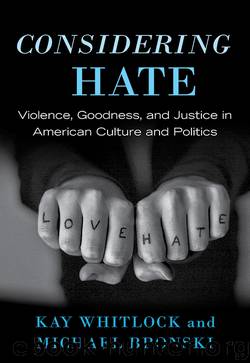
Author:Kay Whitlock [Whitlock, Kay; Bronski, Michael]
Language: eng
Format: epub
ISBN: 978-0-8070-9192-0
Publisher: Beacon Press
Published: 2015-04-05T04:00:00+00:00
ENDLESS WAR
The presumption that justice, and, even goodness, can be obtained through force is completely congruent with the bellicose language of war frequently used to describe human interactions and mobilize constituencies for political campaigns and even social justice work. War occupies a huge place in the Western imagination. It is enshrined in myths, folktales, and literature. It is understood to be the inevitable, logical conclusion to personal and national disagreements. The myth of war is that it wins back honor and power. It has been the impulse behind much of US policy throughout its history. In the public imagination, and popular culture, the horrors of war are almost always offset by its honor and its integrity.
The militarized metaphor of war has been used for centuries. The idea of a war between good and evil is a staple of theological and religious writing. When someone is pulled in two directions, she is said to be at war with herself. Notably, “the war between the sexes” is commonly used to describe gender relationships. War metaphors are ubiquitous in our daily speech: battlefield, join the ranks, war zone, no man’s land, crossfire, blockade, bombshell, foxhole, hold down the fort. War imagery even brings the hint of violence to sex when Jean Harlow and Marilyn Monroe are referred to as blonde bombshells. Since the 1950s, war metaphors have become a staple of US public policy. They are easily adapted to both scholarly and popular writing about criminology, where urban areas are called “war zones,” law enforcement agents are on the “front lines,” and police “launch” a new initiative to curtail crime. Our language is a language of war.
Lyndon Johnson introduced “the war on poverty” in his 1964 State of the Union address as part of his plan for the Great Society. In 1971 Richard Nixon signed the National Cancer Act and declared a war on cancer. Later that year Nixon called for a war on drugs. This was an early stage of Nixon’s “tough on crime” policies. These policies, a public relations move, were popular because of media panics surrounding the “lawlessness” of antiwar protests, the counterculture, drug use, and changing sexual mores. In 2011 George W. Bush declared a war on terror.
In the media, the language of war is used by conservatives and liberals. The October 26, 1998, issue of Time described Matthew Shepard’s death as part of a “War Over Gays.” Rolling Stone’s March 18, 1999, issue featured “The Holy War on Gays.” The New York Times ran an editorial on July 27, 2013, titled “Mr. Putin’s War on Gays.” In 2011 Robert Reich, former secretary of the treasury and liberal commentator, began using the phrase “the war on workers’ rights,” which was taken up by the Teamsters as an organizing slogan at the end of 2013. In the 2012 election Democratic leaders Nancy Pelosi and Barbara Boxer, focusing on Republican resistance to reproductive rights, accused Republicans of waging a “war on women.” The phrase quickly became headline material in print and
Download
This site does not store any files on its server. We only index and link to content provided by other sites. Please contact the content providers to delete copyright contents if any and email us, we'll remove relevant links or contents immediately.
| Anthropology | Archaeology |
| Philosophy | Politics & Government |
| Social Sciences | Sociology |
| Women's Studies |
Nudge - Improving Decisions about Health, Wealth, and Happiness by Thaler Sunstein(7671)
The Fire Next Time by James Baldwin(5399)
iGen by Jean M. Twenge(5393)
Adulting by Kelly Williams Brown(4541)
The Sports Rules Book by Human Kinetics(4357)
The Hacking of the American Mind by Robert H. Lustig(4348)
The Ethical Slut by Janet W. Hardy(4228)
Captivate by Vanessa Van Edwards(3824)
Mummy Knew by Lisa James(3666)
In a Sunburned Country by Bill Bryson(3515)
The Worm at the Core by Sheldon Solomon(3464)
Ants Among Elephants by Sujatha Gidla(3446)
The 48 laws of power by Robert Greene & Joost Elffers(3179)
Suicide: A Study in Sociology by Emile Durkheim(2999)
The Slow Fix: Solve Problems, Work Smarter, and Live Better In a World Addicted to Speed by Carl Honore(2985)
The Tipping Point by Malcolm Gladwell(2884)
Humans of New York by Brandon Stanton(2854)
Handbook of Forensic Sociology and Psychology by Stephen J. Morewitz & Mark L. Goldstein(2684)
The Happy Hooker by Xaviera Hollander(2677)
